
A few years back, when people spoke about brand communication, they usually meant real humans writing, speaking, designing, and replying to customers. There were marketing teams, support desks, social media managers, and content writers. Tech was there, but only in the background. Now it is 2026. And honestly, the scene looks completely different. A lot …
Generative AI and Consumer Trust: The Silent Shift in Brand Communication in 2026
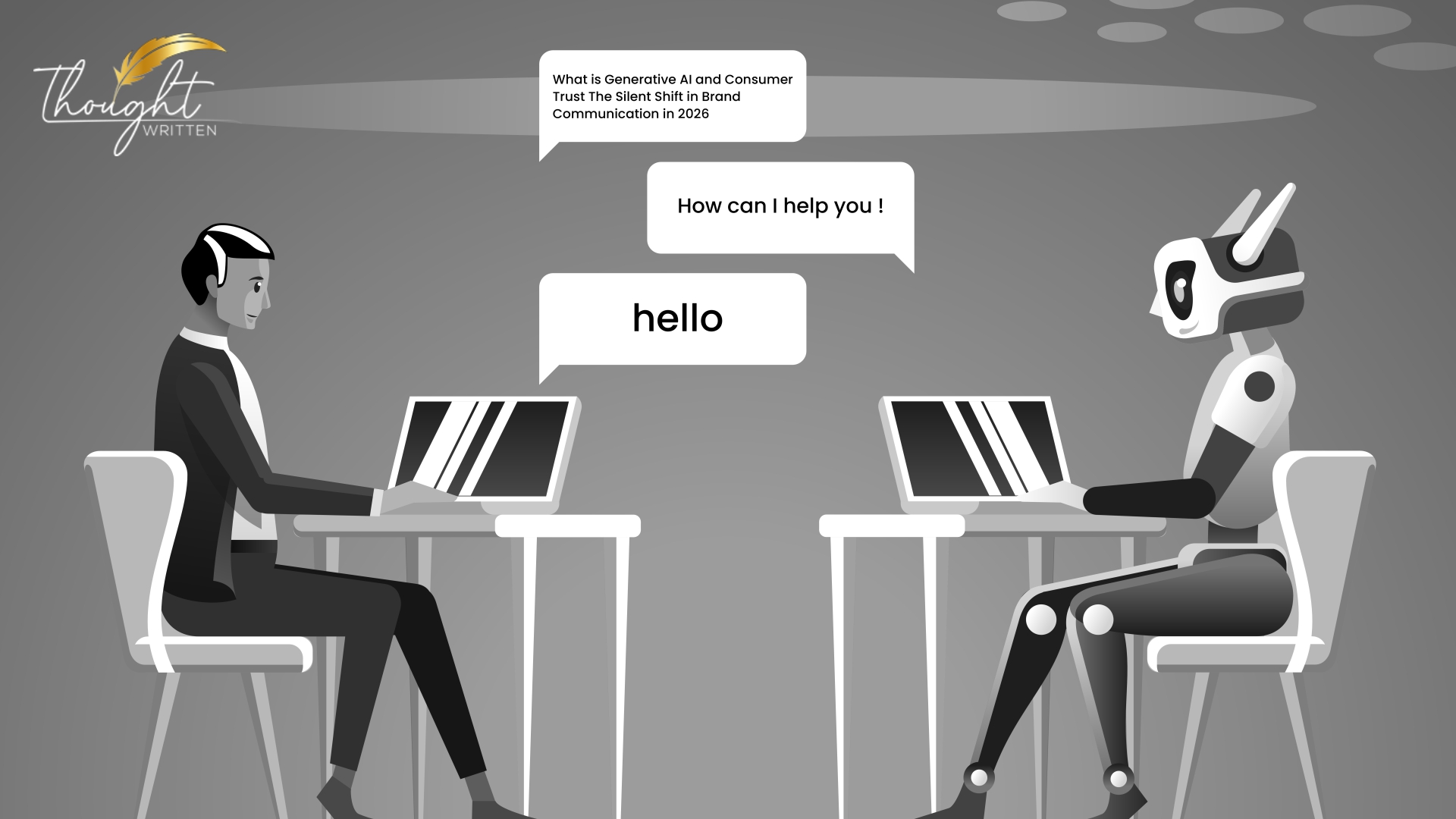
A few years back, when people spoke about brand communication, they usually meant real humans writing, speaking, designing, and replying to customers. There were marketing teams, support desks, social media managers, and content writers. Tech was there, but only in the background. Now it is 2026. And honestly, the scene looks completely different. A lot of what we read from brands today is at least partly written by generative AI. Emails, website copy, product descriptions, chat replies, captions, recommendations, blog articles, even apology messages; somewhere in that chain, AI is involved.
And this brings up a simple but important question:
“If AI is talking more on behalf of brands, what happens to consumer trust?”
Because trust has always been emotional. People trust when they feel honesty, warmth, and clarity. When communication feels human. So what happens when the human part starts to blur? Let’s slow it down and look at it gently.
How AI quietly became the new brand voice
At first, AI in communication sounded like a novelty. Something cool to try. But soon brands realised that AI could reply faster than any human team ever could. It did not get tired. It did not take weekends off. It could adjust tone, style, and language. It could talk to thousands of customers at once. So naturally, companies started using it.
Marketing teams use AI to brainstorm and draft. Customer support teams rely on AI chat systems to manage endless questions. Content teams use it to write first drafts. And sometimes whole campaigns are shaped around AI-assisted creativity. For businesses, that makes sense, faster work, lower cost and more consistency. But while this change was happening on the inside, something more subtle began changing on the outside.
Consumers started to notice. People know when they are talking to AI. By 2026, most people can sense AI, even if nobody tells them. Maybe the reply feels too neat. Maybe the phrases feel slightly generic. Maybe the tone sounds warm but not quite alive. And people respond in different ways. Some really don’t mind. They just want answers quickly. If the problem gets solved fast, they are happy. In fact, for many simple customer queries, AI has actually improved the experience. But others feel a little distant when they realise the “person” responding is not actually a person. Not upset, not angry. Just… less connected.
And connection is where trust lives. What consumers still need from brands, even in a world full of automation, people still look for the same basic emotional things:
• kindness
• fairness
• honesty
• clear communication
• a sense of realness
AI can copy empathy in language. But it cannot truly care and sometimes that difference, even if small, is felt. For example, if someone writes in with a sensitive complaint or a stressful situation, a purely automated response can feel cold. Even if the words are polite.
So the rule becomes simple: AI can communicate. Humans create trust.
And the best brands are figuring out how to balance both.
Why transparency suddenly matters so much
Something interesting has happened in 2026. People don’t only care what you say. They also care how it was created. When brands openly say that AI supports their communication, many consumers actually appreciate the honesty. It feels respectful. Clear. Straightforward. But when brands use AI silently, pretending everything is human-written, some people slowly start losing trust. Not always loudly but quietly over time. So transparency has turned into a new form of credibility.
A simple acknowledgement like:
“This message was assisted by AI and reviewed by our team.”
goes a long way.
The personalisation problem. AI has made personalisation incredibly advanced. Emails use names, websites recommend what you might like and chat replies mention your previous purchases. Sometimes this is helpful. It makes the experience smoother. But there is a thin line between helpful and weird. When personalisation feels too accurate, some people start wondering how much brands really know about them. That can trigger discomfort and when discomfort appears, trust slips away. So the real challenge is balance. Human warmth without crossing boundaries. Customer support is where trust breaks or builds. Customer service is probably the biggest test of all.
AI chatbots can fix a lot of simple problems very quickly; track an order, reset a password, explain a policy. For that, they work great. But when the situation is emotional, complicated, or sensitive, people still want a real human. A chat loop during a stressful moment can make someone feel ignored, unheard, or brushed aside. And that experience travels. It shapes how the entire brand is seen.
So maybe the rule is:
AI should handle tasks. Humans should handle feelings.
AI and brand storytelling
In 2026, AI is also being used to help brands tell stories. Blogs, campaigns, mission statements, newsletters. A lot of this is now created with AI support. This is helpful for teams and it makes content creation faster. But there is a quiet risk: sometimes the story ends up sounding perfect but empty. Beautiful words. No real heartbeat. Consumers are beginning to sense that difference. They respond more strongly to content that feels lived, not manufactured. That means real experiences, real values, real mistakes, real learning. AI can help shape the words. But the meaning still has to come from people. Ethics is becoming part of the brand personality People today want to know how brands use AI. Whether data is safe. Whether communication is honest. Whether automation is fair. So ethics has moved from backstage to the spotlight. Brands that behave responsibly and communicate clearly about AI use gain trust. Those that hide it or over-automate without care slowly lose emotional connection.
Simple truth: Consumers do not hate AI. They dislike being misled.
The real shift in 2026
The change is not loud or flashy. It is quiet. People are no longer only reacting to what brands say. They are reacting to how genuine the voice feels. Whether it feels thoughtful. Whether it feels open. Whether it still feels human, even when AI helps shape the words. So the winners in 2026 are not the brands using the most AI. They are the brands that use AI with sensitivity. They let tech handle the heavy lifting. They let humans hold the heart of communication. And that balance is where trust grows.
Looking ahead
As AI keeps evolving, the relationship between brands and consumers will keep evolving too. Automation will probably increase. Content will be created faster. Interactions will become even more responsive. But the human need for sincerity will not disappear. So maybe the real goal now is not to replace human communication with AI, but to let both work together. Gently. Honestly. Without pretending.
Because trust isn’t built through perfect sentences. It is built through real connection, fair intent, and respect. And no matter how advanced AI becomes, those things still belong to people.