
Sector Specific Imp: Manufacturing and Make in India The proposed reforms in tariffs will generate several benefits to India’s manufacturing sector. This will make it easier for Indian manufacturers to compete both domestically and globally. This is important at this particular stage sinceIndia is establishing itself as a viable option as far as manufacturing is …
Union Budget 2026:Sector Specific Implications:
Sector Specific Imp:
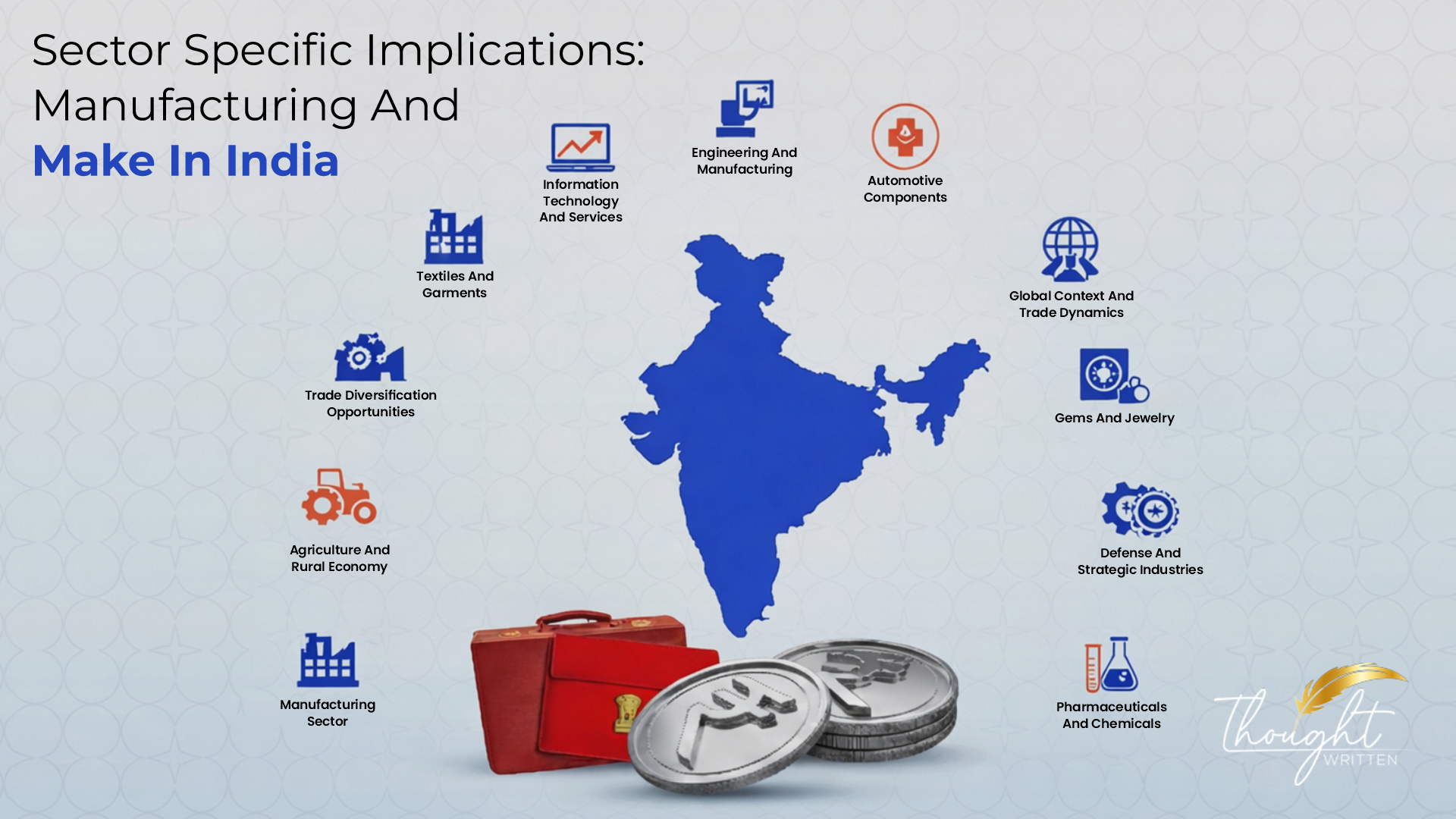
Manufacturing and Make in India
The proposed reforms in tariffs will generate several benefits to India’s manufacturing sector. This will make it easier for Indian manufacturers to compete both domestically and globally. This is important at this particular stage sinceIndia is establishing itself as a viable option as far as manufacturing is concerned and many firms are seeking it as a means of diversification away from China.
Information Technology and Services
Services trade remains healthy with negotiations seriously pursued in most FTA negotiations. Services trade is the area with the strongest developing momentum in the entire realm of external relations. Services are an area with great potential for the resilience of the Indian economy.
Agriculture and Rural Economy
Moreover, with favorable monsoon rains and improving rural infrastructure, the agriculture sector has contributed positively to economic growth. Budget 2026 is expected to build on favorable policies toward rural infrastructure, agriculture modernization, and farmer welfare.
Defense and Strategic Industries
Modernization of defense continues to be an important agenda, anticipating additional capital spend in domestic procurement, R&D, and self-reliance programs, consistent with our national strategic objectives and government intentions to source less from outside.
Global Context and Trade Dynamics
US Tariff Uncertainty
Under the tax cuts and tariff measures advocated and initiated by President Donald Trump, uncertainty exists as average tariffs have seen sharp increases, which may result in feeding inflation domestically, thereby choking consumption and ultimately reducing tariff revenue. Export competitiveness will thus require to be factored in this challenging environment.
Trade Diversification Opportunities:
China Factor
Even the trade diversion away from the US would have some scope, with other countries like the EU and the UK playing a role in it through trade agreements, where the export of textiles and leather products may revive. The recent trade agreements and negotiations with the major economic groups would open new scope to export more.
As having foreign reserves of more than 3.2 trillion dollars gives China excess global savings, for boosting global demand, China must shift its role from being a global saver to a global buyer. The development in the economic policies of China will affect India.
Challenges and Opportunities:
Structural Issues
Exorbitant Burden of Compliance: Firms are still drowning under over 8,600 annual compliance requirements despite labor codes supposedly simplifying the system. Full-fledged ease of doing business reforms remain pending to attract investment.
Public Debt Sustainability: DebttoGDP ratio of 81 percent, fiscal consolidation without comprising growth is a big task. The government aims to reduce this ratio to 50 percent by 2031, entailing judicious prioritization of expenditure.
Private Investment Revival: This crowding out of private investment by public spending cannot be broken unless there is fiscal restraint, regulatory reforms, ease of doing business, and clear policy frameworks that give confidence to the entrepreneurs.
Emerging Opportunities
Global SC Reconfiguration: Geopolitical tensions and the “friendshoring” paradigm create opportunities for investments into the country and increasing prominence into the global supply chain.
*Digital Economy*: India’s lead in digital payments and developments in its albeit nascent tech industry suggest future prospects for digital services and technology exports.
Green Transition: High public capital expenditure in areas of infrastructure and green transition-based infrastructure development and renewable energy ensures demand sustainability as a major contributor to growth. The emergence of green energy across the world also creates opportunities for India in its creation and services.
Regional Perspective:
Gujarat and India’s Manufacturing Hub
The consequence of this is that some of the states that will stand to benefit as a result of these reforms are Gujarat and some cities within it like Rajkot. This is owing to its position as one of the leading industrially developed states in India.
There are areas where Gujarat’s major industries stand to benefit:
Reduced input costs through tariff rationalization would help Gujarat’s major industries,
- Engineering and manufacturing
- Pharmaceuticals and chemicals
- Textiles and garments
Automotive components:
Gems and Jewelry
Also, local businesses in Gujarat should get ready to face a competitive challenge within the local as well as export trade as tariff-related reforms come into play.
Policy Recommendations and Way Forward
immediate priorities
Comprehensive Tariff Reform: Implement the recommendations made by the GTRI, namely the imposition of zero customs duties on raw materials needed in the production of industrial goods and the imposition of standardized low customs duties on finished goods.
Customs Modernization: Develop an integrated electronic duty schedule, send self-contained information notifications, and enhance risk management data programs to reduce compliance costs and transaction costs. Export Facilitation: Redesigning the export incentive system, streamlined duty drawback systems, providing sector-specific support to labour-intensive industries.
Medium Term Reforms
Regulatory Simplification: Undertake comprehensive ease of doing business-type reforms in areas like the Insolvency and Bankruptcy Code with a particular focus on deregulation and de-regulatory steps.
Infrastructure Investment: Continue to sustain healthy capital investments in infrastructure while eventually optimizing efficiency through private sector participation in innovative financing methods.
Skill Development: The education and skill development sectors should focus more on industry needs, especially in newer technologies and industries like manufacturing.
LongTerm Vision
Sustainable Fiscal Path: Ensure the achievement of the objectives by reducing the debt to GDP ratio to the desired level of 50 percent by the year 2031.
Revival of Private Investment:
Make appropriate provisions for the revival of private investments by ensuring stability in policies and government intervention in terms of creditors and credit itself.
Global Integration: Strengthen global value chain engagement through trade agreements, easier trade via customs procedures, as well as competitiveness in both manufacturing activities and services.
Conclusion: Balancing Reform and Growth
With the Union Budget 2026, India presents a historic opportunity not just to resolve many of the basic issues facing its customs and revenue codes but also to carry on with the momentum of growth that has created significantly better rates of growth than any other major economy of the world. As such, the options facing policymakers in Delhi today are clear. Should they stick with business as usual, or seize a historic chance to revitalize growth.
The ultimate aspiration should be so inspiring that when the 2027 Budget is presented, words like reform are just no longer necessary—because we would have finished with our structural challenges. This demands political will, engagement of stakeholders, and preparedness to upset established power balances for the greater good of our nation.
The nature of tariff reform introduced in India by GTRI stands a high promise of transforming India’s economic environment through enhanced infrastructure development and increased investment in human capital and technology. The ease of conducting business in India will not only enhance its competitiveness but also revive private investments, which are critical ingredients of broad-based and rapid economic growth.
The Budget 2026 will prove to be a major pronouncement regarding the economic policy of the government, and as a result, will be especially important to those in the business, investment, and general citizenry of not just the country but, more specifically, cities like Gujarat, especially Rajkot, as well as other manufacturing centers.
As India aims to attain the projected Viksit Bharat 2047 of being a developed country, the decisions integrated into the Budget 2026 will have significant implications for the growth of India. It signifies not merely adjustments to India’s tariff reform and investment revitalization but a fundamental recast of India’s growth strategy in the 21st century. With the success of these policies, India may emerge as a globally competitive manufacturing and services center that may propel to growth and prosperity of 1.4 billion citizens.