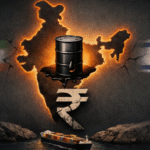
Introduction: Felt Right Here at Home, A War Thousands of Miles Away. The war between Iran and Israel hurts the economy of people who do not even have to live in the Middle East to experience the pain. It may be time to refill your petrol tank, time to stock up your groceries or time …
Iran-Israel War and the Economy of India: The Increasing Oil Prices, the Weak Rupee and Trade Destabilization.

Introduction: Felt Right Here at Home, A War Thousands of Miles Away.
The war between Iran and Israel hurts the economy of people who do not even have to live in the Middle East to experience the pain. It may be time to refill your petrol tank, time to stock up your groceries or time to check your stock portfolio – but no matter what, the ripples of this conflict are knocking at your doorsteps in India. And they are arriving fast.
Crashing stock markets to a falling rupee, the real-time consequences of this war on the economy are already underway. It is no longer the prerogative of economists to understand what is occurring and why. It is a must-have thing every Indian citizen has nowadays.
The Indian Dangerous Oil Dependency–the Essence of the Problem.
It also heavily depends on crude oil imports, which is over 80 percent of its needs, and is therefore very susceptible to any form of unrest in the Middle East. A significant part of this oil passes through the Strait of Hormuz, which is one of the most important and narrow energy regions in the world.
About 35-50 percent of the Indian crude imports and a significant part of LNG deliveries transit via this small passage. Any interference would instantly increase the freight, insurance rates, and the world oil prices.
The communications of the Iranian Revolutionary Guard Corps has warned commercial vessels against passing the strait. At least three tankers have been attacked, insurance companies have pulled their covers and ship owners and oil majors have halted movements. This is not some far off menace but is taking place.
The Oil Prices are Rushing and India is paying the price.
Futures in the Brent crude soared and hit a peak of up to $82.37 a barrel, the highest since January 2025, on increasing worries over supply shocks following attacks on the Iranian oil sector.
The implications to India are punitive and hurtful. Analysts estimated that a persistent rise of 10 per barrel in crude price might increase the annual import bill of India by 13-14 billion, increase the current account deficit, and decrease the rupee. The increased fuel prices would trickle down into the transportation and logistics expenses which would support inflation in retail prices and ultimately food prices.
In simple language – when oil increases, everything increases. Your fare on auto-rickshaw, your vegetables, your electricity. The chain reaction reaches all the spheres of everyday life.
The Rupee Under Pressure – why your money is worth less.
High crude oil prices increase the importation bill in the country, expand the current account deficit, depreciate the rupee, fuel inflation, and create outflows in foreign capitals.
Increased oil imports lead to more dollar demand whereas outflows of funds out of the emerging markets are caused by the international risk avoidance. The trade deficit that is increasing as a result of high-cost imports of energy exerts structural strain on the currency and would likely drive the dollar-rupee pair to historic levels.
A devalued rupee is a vicious cycle – as imported oil will be that much more costly in Indian rupee, it will increase inflation, and the rupee will fall even further.
Stock Markets, Farmers and Gulf Workers: The Greater Evils.
The Indian equity indices plummeted, the rupee lost value over the dollar and the price of crude oil shot up on the initial day of the conflict.
Indian farmers are not spared outside markets. The Gulf region requires quite a number of fertilisers such as ammonia and urea. In case they cannot be obtained at reasonable prices it will be more costly to manufacture the goods and will also impose further strain on the government to provide subsidies to the farmers.
And close to nine million Indians working and residing in West Asia have their future under doubt. Gulf remittances are a vital Indian buffer that is at risk in case the oil activity is reduced. To remittance-dependent states this may directly be converted to lower household income and consumption in the rural areas.
What Can India Do? What Should You Do?
The government of India is already making a reply. Prime minister Narendra Modi hosted a Cabinet Committee on Security meeting to examine the aftermath of the increasing conflict with great emphasis on the supply of crude, shipping routes and the Indian safety abroad.
An individual can do the following plans as the wisest steps at the moment, namely cutting down on unwarranted fuel usage, diversification of investments such as precious metals and not to panic-sell in equities markets. Geopolitical shocks usually lead to short run market pain but long run fundamentals are likely to improve.
Concluding Remarks: India needs to lessen its power insecurity.
The war between Iran and Israel has again revealed a bitter truth that the Indian economy is too dependent on Middle East peace. Energy analysts cite this crisis and point to the structural helplessness of India in relation to imported fossil fuels and that India should leverage this opportunity to hasten the electrification of power and transport as a long-term energy insecurity solution.
There is nothing better to keep you safe than to be informed until that time comes. Monitor the oil prices, monitor the rupee, and make financial decisions in the bigger picture.