
You have employed the costly serums.you have taken the ten steps of practices, avoided dairy products, changed cleansers thrice, and included retinol. And your skin is still breaking out. Still red. One that is still inflamed in such a way that nothing topical appears to be able to fix it totally. This is one of …
The Gut-Skin Axis: How Your Digestive Health Is Writing Itself All Over Your Face
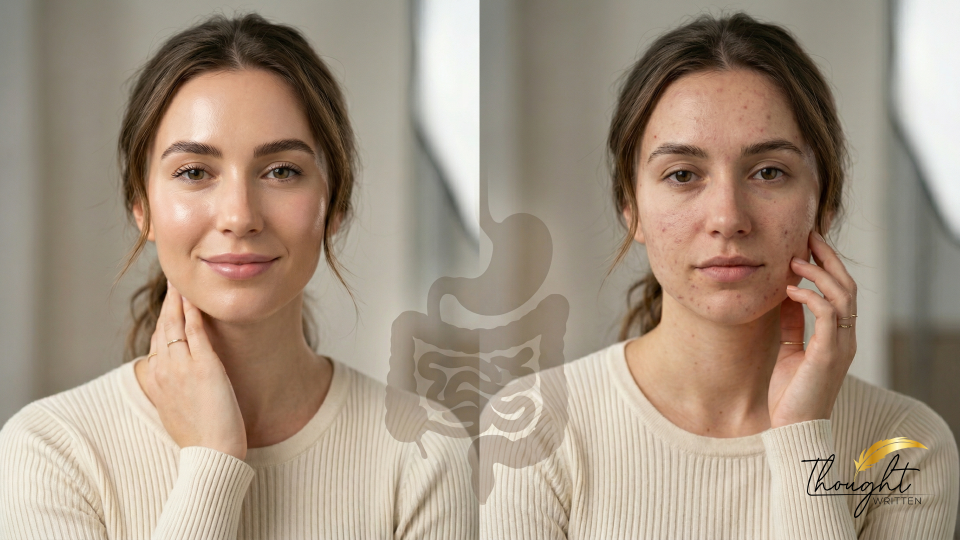
You have employed the costly serums.you have taken the ten steps of practices, avoided dairy products, changed cleansers thrice, and included retinol. And your skin is still breaking out. Still red. One that is still inflamed in such a way that nothing topical appears to be able to fix it totally.
This is one of the possibilities that the mainstream skincare industry has been shown to realize: it may not even be a problem on your skin. It could be occurring 30 feet of intestinal tissue distant, in your gut, silently transmitting a report of inflaming chemicals your face with each day.
This is the gut-skin axis. It used to be regarded as a marginal concept. By the year 2025 and 2026, it will be the focus of peer-reviewed studies in the journals of gastroenterology, dermatology, and immunology and it is changing the way we conceptualize acne, rosacea, eczema, and psoriasis.
What the Gut- Skin Axis Really Means.
The gut skin axis is the two way communication of your skin and your gastrointestinal tract. It functions via collective immune pathways, metabolic waste of microbes in the blood, and coresponsive regulatory mechanisms that react to the signals of both organs at the same time.
A 2025 peer-reviewed review published in Tandfonline refers to this as a system in which three fundamental channels operate, namely:gut and skin microbiota communicating through common immune pathways; systemic circulation of bactorial metabolites and inflammatory molecules through the gut to the skin; common receptor pathways 9 such as vitamin D receptor and aryl hydrocarbon receptor) that regulate both tissues simultaneously.
In a second review in the world of journal of Gastrointestinal pathophysiology of 2025, it was affirmed that impairment of gut homeostasis (that is, dysbiosis and heightened intestinal permeability) is now considered to cause acne, psoriasis, atopic dermatitis, and rosacea.
There is no longer a hypothesis. It is a mechanistic conceptualization of biology having clinical implications.
The Gut Talks to the skin: Three mechanisms that have been verfied.
Dysbiosis and immune stimulation:
There are about 100 trillion microorganisms in your gut. This community is heterogeneous and balanced in a healthy state generating anti-inflammatory compounds and controlling immune
Cells produce pro-inflammatory cytokines. These cytokines get into the bloodstream and pass into the skin where it is the cause of the inflammatory reaction that manifests itself as acne, rosacea or eczema. According to the 2024 American journal of lifestyle medicine (PMC11556587), this pathway is well documented: dysbiosis will trigger pattern recognition receptors, T-cells activation, systemic inflammation, which will be deposited directly on the skin tissue.
Intestine permeability- the “leaky gut” pathway.
The lining of your intestine is one cell layer thick wall that can be held together by the light junction proteins. It is under these conditions that the bacterial endotoxins or lipopolysaccharides(LPS) may enter the bloodstream when those proteins become weakened through poor diet, chronic stress, alcohol intake, or excessive use of antibiotics. LPS is an effective inflammatory stimulus. It stimulates the innate immune system at the trace levels, increasing the levels of the inflammatory cytokines such as IL-6, TNF-a, and IL-1b. The molecules are circulating throughout the system and are released into the skin, which forces chronic low-grade inflammation. Importantly, this pathway was specifically implicated in psoriasis, atopic dermatitis, acnes, and lichen planuses by a bidirectional mendelian randomisation study, which does not show correlation but genetic casuality.
Short- chain fatty acids- the incentive of the gut to the skin.
It is the process that has been made most evident with regard to 2024 and 2025 studies. The positive gut bacteria break down the dietary fibre by fermentation to give short-chain fatty acids (SCFAs) mainly butyrate, propionate, and acetate. These are, in effect, the words that your gut microbiome is talking to your skin.
One of the pioneering studies on the mechanism of action of butyrate, published in the journal mucosal immunology, showed exactly how this happens: butyrate directly induces the differentiation of keratinocytes, the cells that make up the skin barrier by forming structural lipids and proteins. Increased fiber implies increased beneficial bacteria, increased butyrate, improved skin barrier, reduced inflammation, reduced allergens permeability, reduced flares.
The converse is also observed; reduced fiber, reduced SCFA generation, poor barrier, chronic inflammation.
The Diet Connection
Foods which cause the most direct harm to the gut-skin relationship are also the most widespread foods in contemporary diets which include ultra-processed foods, refined sugar, alcohol, seeds oils, and low fiber eating habits. These decrease the microbial diversity, eliminate SCFA-producing species, and encourage dysbiosis. On the other hand, the nutritional regime best supported by the gut-skin study is an inflammatory process.
What You Can Actually Do?
The evidence justifies a number of particular action-oriented interventions. The first is to consume more fiber and make it more varied. Different bacteria digest different fibers,and hence variety is important. The goal is 20 various types of plant food each week, which the huge microbiome studies provide as a maker of significance in practice of any considerable contribution to the diversity.
Second, include fermented foods: like yogurt,kefir,kimchi,sauerkraut, and kombucha have demonstrated clinical difference in increasing the diversity of microniome.
Third, avoid ultra-processed foods,refined sugar and alcohol to a considerable degree- all of these destabilize tight junctions and nourish symbiotic microbes.
The Bottom Line
Your skin is a manifestation of what is inside you. When it is inflamed persistently, when it breaks out constantly. When it responds to everything then it is often telling you that this inflammatory message is being sent out by what is going on internally, not by what you are or are not putting upon the surface.
No serum fixes a leaky gut. Butyrate is not replenished in any retinol. None of the cleansers reestablished microbial diversity.
The gut skin axis is not a different concept of health. It is biology which is peer-reviewed, mechanistically tested, and clinically relevant. And the first step that you can take it in regards to your approach to skin health may be the most important step in understanding skin health