
India’s space story has never been only about engines, numbers, or shiny machines pointing toward the sky. It has always carried a quieter layer underneath, built on patience, long-term thinking, and a habit of learning from every single launch. The recent success of the LVM3 M6 mission, which carried the BlueBird Block 2 satellites into …
LVM3-M6 Success: ISRO’s BlueBird Block-2 Mission Boosts India’s Commercial Space Ambitions
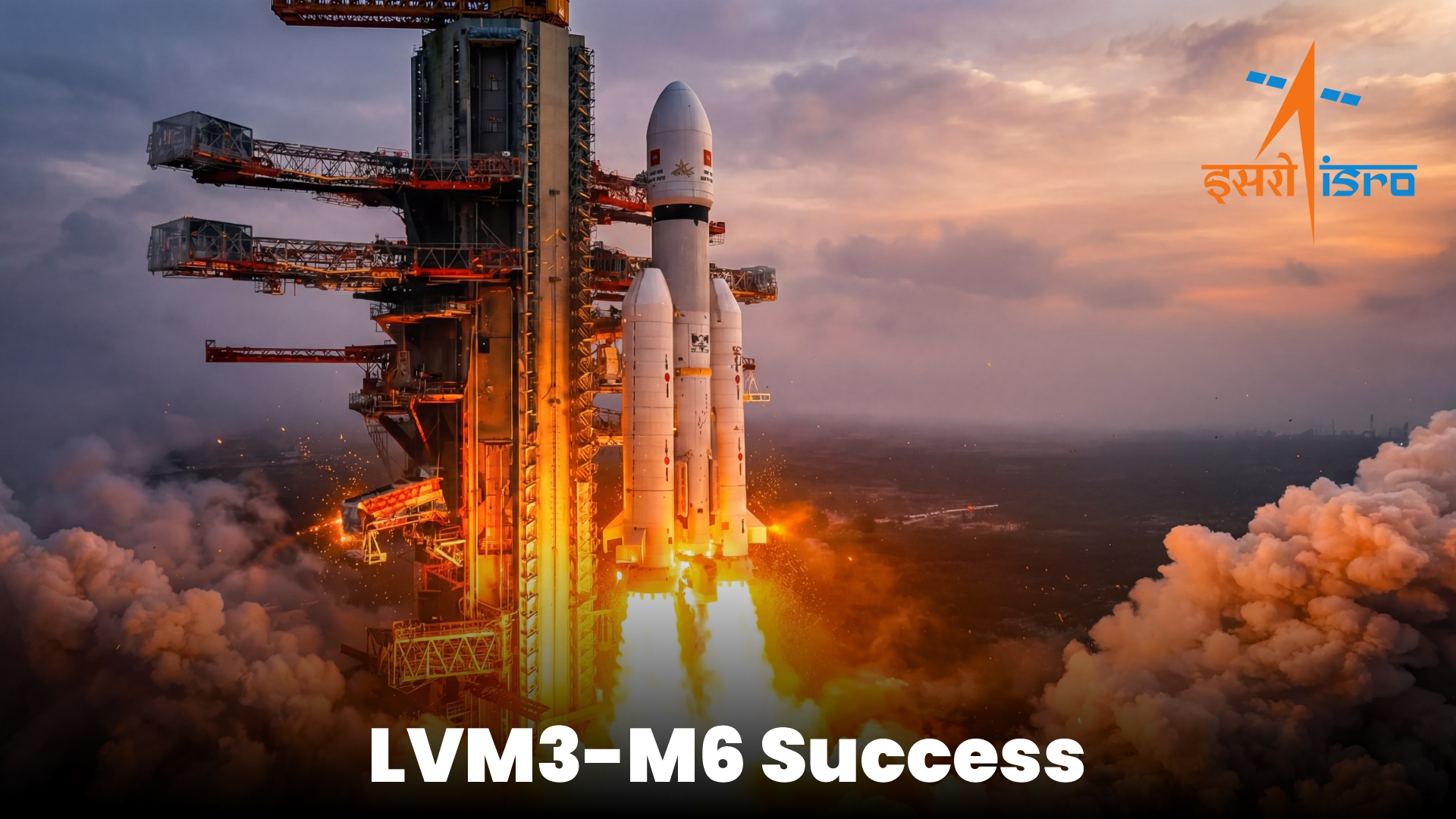
India’s space story has never been only about engines, numbers, or shiny machines pointing toward the sky. It has always carried a quieter layer underneath, built on patience, long-term thinking, and a habit of learning from every single launch. The recent success of the LVM3 M6 mission, which carried the BlueBird Block 2 satellites into orbit, feels like another steady step in that direction. It is not a loud celebration. Instead, it is proof that India is slowly moving from being just a capable space-going nation toward becoming a confident commercial space partner for the world.
This mission took off on ISRO’s heaviest and most trusted rocket, the Launch Vehicle Mark 3. Over the last few years, LVM3 has earned a reputation for being a reliable heavy lifter. Each successful mission adds to that trust. With every clean launch, global customers see India not only as an affordable option but also as a dependable one. Confidence grows quietly like that, without fanfare, one launch at a time.
What This Mission Really Signifies
Earlier, most Indian space launches mainly served national research needs or scientific exploration. The LVM3 M6 launch was different. It was driven primarily by a commercial objective. The BlueBird Block 2 satellites were launched under a contract managed by NewSpace India Limited, which acts as the commercial arm of ISRO. That basically means this mission directly supports India’s space economy instead of working only as a research milestone.
The BlueBird satellites themselves form part of the fast-expanding network of low earth orbit constellations that enable everything from communication and climate analysis to navigation support and data-driven services. Instead of India simply watching this global race from a distance, it is now participating, delivering, and supplying launch capability to the world. Slowly but surely, the country is stepping into the same competitive arena as agencies like SpaceX, Arianespace, and Roscosmos.
Why LVM3 Matters So Much
LVM3 has become the backbone for India’s heavy launch missions. It can lift multiple satellites at once and handle large payloads, which is extremely valuable for constellation operators. It has already supported landmark missions such as Chandrayaan-3 and key stages of India’s human-spaceflight preparations.
Commercial space customers care deeply about one thing above all: reliability. A single failure has the power to shake confidence for years. But when a rocket keeps delivering consistent results at reasonable cost, clients begin to trust it. That is the quiet power of LVM3. The M6 success shows that India has reached a point where engineering strength, performance stability, and cost efficiency meet comfortably.
Understanding BlueBird Block-2 A Little Better
The BlueBird Block 2 satellites launched under this mission are designed to support communication, data services, and observation requirements. They contribute to the global digital backbone that modern life depends on. Today, countless systems rely on satellite support. Logistics, mapping, aviation, shipping, environmental monitoring, climate research, disaster management, and even agriculture are deeply connected to space-based data.
So when India launches such satellites, it is not merely lifting hardware into the sky. It is helping build the invisible digital infrastructure that supports real-world activity across continents.
A Message To The Global Space Market
One of the biggest impacts of the LVM3 M6 success is perception. International companies now see India as a credible, stable, and commercially sensible launch partner. Indian launch costs tend to be significantly lower than those in several other countries, while mission quality remains strong. That combination is rare and powerful.
Over time, missions like these can lead to long-term launch agreements, technology partnerships, and global collaborations that strengthen India’s space ecosystem even further. In simple words, India is gradually becoming a preferred launch destination rather than just an interesting alternative.
Strengthening India’s Private Space Ecosystem
Another ripple effect of this mission is the energy it brings to India’s growing private space industry. Startups and companies working on small launch vehicles, satellite manufacturing, space software, and data analytics benefit indirectly from every successful large-scale mission.
When ISRO demonstrates commercial delivery capability, it creates confidence, opportunity, and infrastructure that private players can build upon. This aligns closely with the government’s vision of encouraging private participation and public-private collaboration in the space sector.
We are moving toward a future where ISRO continues leading high-end research and national missions, while private companies help expand commercial activity and technological innovation within the country.
India’s Place In The Larger Space Economy
The global space economy today is worth hundreds of billions of dollars, and that number is still rising. Interestingly, most of this value does not come from rockets alone. It comes from services powered by space infrastructure. Communication networks, navigation systems, weather and climate analysis, remote sensing, and space-based industry form the real financial backbone.
By proving its launch strength through missions like LVM3 M6, India is positioning itself to earn a larger role in this worldwide ecosystem. Each success improves India’s credibility across three major pillars: technical capability, operational reliability, and commercial competitiveness. These pillars define long-term leadership in the space market.
The Culture Behind The Success
One of ISRO’s biggest strengths has always been its disciplined learning culture. Nothing is rushed. Every deviation is studied. Every mission becomes a case study for the next improvement. That habit builds quiet confidence over time.
So when LVM3 performs well, it is not luck or coincidence. It is the result of years of careful refinement, documentation, team-learning, and engineering maturity.
Beyond Technology: The Emotional Impact
There is a human side to this story as well. Every successful launch inspires young students, dreamers, and engineers across the country. Children watch rockets take off and imagine futures that stretch far beyond their everyday surroundings. That sense of pride strengthens national spirit and curiosity.
It is difficult to measure that emotional influence with graphs or reports, but it shapes generations in its own way.
The Road Ahead
Of course, challenges remain. Global competition is intense. Technology changes quickly. Launch frequency needs to improve, and India must continue investing in research, infrastructure, and training. But the country has a strong advantage. It has learned how to do more with less while maintaining steady focus. That patience, combined with engineering discipline, will continue guiding India’s path.
A Mission That Means More Than A Single Launch
So the LVM3 M6 mission carrying BlueBird Block 2 satellites is not just another technical success. It represents a wider movement toward commercial maturity. It strengthens global partnerships, proves that Indian launch systems can handle complex payloads consistently, supports private industry growth, and builds India’s standing as a dependable space services provider.
Each successful mission is like a stepping stone laid carefully in a long pathway. From exploration to economic opportunity, India’s space journey continues to expand in meaning and impact. With its blend of innovation, affordability, and engineering depth, the country is slowly but surely shaping its place in the future global space landscape.