
You must have heard that the term blockchain is being bandied about alongside Bitcoin, NFTs, and Web3. However, what exactly is it and why should one who is in his/her 20s or 30s take care of it at this moment? Let's cut through the noise. Cryptocurrency is not the only thing about blockchain. It is …
The Technology that is Changing Everything: Blockchain Explained.
You must have heard that the term blockchain is being bandied about alongside Bitcoin, NFTs, and Web3. However, what exactly is it and why should one who is in his/her 20s or 30s take care of it at this moment?
Let’s cut through the noise. Cryptocurrency is not the only thing about blockchain. It is a radically new method of information storage, and information sharing, one that has the potential to transform the way you shop a house, listen to music, earn wages, or even vote.
What is a Blockchain, then?
Imagine blockchain as a common Google Doc but no one can make any changes or remove anything, all the changes are always documented and it is not owned by any individual or corporation.. The data are combined into so-called blocks and each block is encrypted with a special digital fingerprint known as a hash and each block is linked with the previous one creating a chain.
Since this chain exists on thousands of computers at once (a technology known as a distributed ledger), it does not have a single point of failure. No one server to hack, no one company to bribe, no one record to falsify. Decentralization is the essence of blockchain.
Key insight: The conventional databases are owned by a single owner who has it all. There is no owner of blockchain, the network itself takes control, and everything is ruled by mathematical rules, which all people agreed to at the very beginning.
Why Was It Created?
Suppose you would like to purchase a house. You give the money, but who will tell you that the deal went down squarely? Now, you require lawyers, banks, government registry, costly middlemen, whose whole task is to be believed.. Blockchain takes the place of institution trust with math trust.
The first real blockchain was launched in 2008 by an anonymous individual (or organization) known as Satoshi Nakamoto as the basis of Bitcoin. The idea: enable two strangers anywhere in the world to send and/or receive money without involving a bank in between. That notion expanded to become much larger.
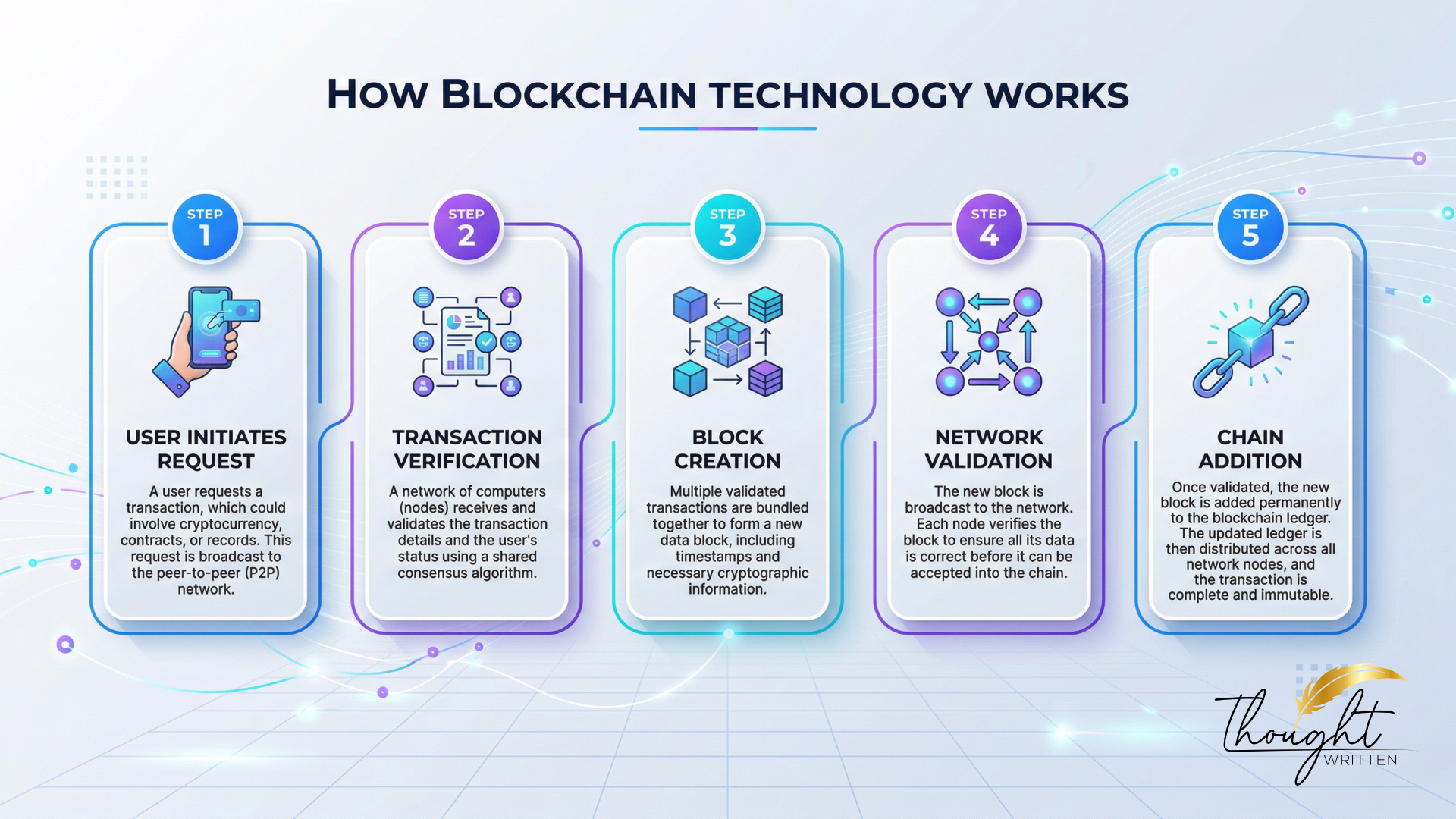
There are 4 basic operations of blockchain transactions:
Step 1 Transaction registered: The data on what has just happened, who were involved in the process, and when is encrypted as a data block.Step 2 Network: Consent Before any permanent writing is done, the majority of the computers in the network must concur that a transaction has been completed.
Step 1 Transaction recorded: The information of what occurred, who took part and when are recorded as a data block.
Step 2 Network provides consensus: The transaction must be agreed upon by the majority of the computers on the network before anything is permanently written. There is no central authority in making decisions in the community.Block 3 is locked in: Once a block is approved, a special hash is placed on it and it is linked to the previous block..
Step 3 Block is locked in: After being approved, the block is encrypted with a distinct hash and connected to the last block. I
It would be practically impossible to alter it, and would mean to rewrite every block.Step 4 Ledger shared immediately: All the network participants are presented with an updated copy of the ledger in real-time.
Step 4 Ledger shared instantly: Every participant on the network receives an updated copy of the ledger in real time.
The enchantment lies in the second step. It is this process that makes blockchain reliable without the need to have a middleman, known as consensus. And when a block is written it cannot be changed: it is permanent, irrevocable, and visible forever.
It Is Not Only About Crypto.
This is what the majority of people overlook; blockchain is not a currency, it is a technology. It is only that Bitcoin and Ethereum are its most well-known applications. The actual shaping is occurring in industries that you touch on in your day-to-day lives.
Music and Media: When the music is played by a label that takes an enormous percentage before it is disbursed to the artists.. Sony Music Japan is already applying blockchain to manage the copyright processing process more effectively.
Retail: Companies such as Amazon are applying blockchain to ensure that all the products sold are not counterfeit, which will trace the products back to their manufacturers to your door.
Energy: Peer-to-peer blockchain means that homeowners have solar panels to sell their surplus power to neighbors without the mediation of an energy company.
Finance: Blockchain-based payment networks can make international transfers that used to take 3 to 5 business days in seconds.
The most interesting idea about all of this is the smart contract, which is a self-executing contract that is directly written into the blockchain. When X occurs, Y is automatically activated. No telephone, no lawyers, no delays. A logistics company has the ability to program payment to discharge the moment a shipment arrives at port. A musician is able to get royalties immediately when a song is licensed.
Public vs. Private: There are various ones.
Blockchains are not all created equal. Decentralized and transparent to anyone, public blockchains such as Bitcoin and Ethereum are accessible to anyone.. Single organizations have control over private blockchains and therefore are faster yet more centralized. In between lie consortium blockchains, shared by a group of companies such as a cooperative. All the types have a purpose of their own based on the amount of openness and control you require.
Bitcoin vs. Blockchain Unravel the Mystery
Bitcoin uses blockchain. Bitcoin is only a car, and blockchain is the engine. Comparing blockchain to Bitcoin is akin to equating the internet with email as being technically related but wholly insane.. There are hundreds of applications of blockchain technology, none of which are related to cryptocurrency.
Why It is Important to You at this Time.
Blockchain is slowly finding its way into your life whether you like it or not. Your digital property, the creator economy you are part of, the supply chains running your brands are all being re-invented on blockchain infrastructure. Being able to understand how it works places you on top of a curve that the rest of the people will only realize in hindsight once everything has already changed.
The essence of blockchain is straightforward and radical Systems that do not need you to trust anybody. That is not merely a technical feature in a world where institutional trust is at historic lows, but a cultural change.
Key Terms to Know
| Keyword | What It Means |
| Blockchain | A chain of permanent, linked digital record blocks |
| Decentralization | No single person or company is in control |
| Distributed Ledger | A shared database spread across many computers |
| Immutability | Data that can never be changed once recorded |
| Consensus | Network majority must agree before anything is saved |
| Hash | A unique digital fingerprint for each block |
| Smart Contract | A self-executing “if this, then that” agreement |
| Cryptography | Encryption that secures all blockchain data |
| Public Key | Your shared identity on the network |
| Private Key | Your personal secret password |
| Bitcoin | The first and most popular blockchain currency |
| Ethereum | A blockchain platform built for apps and contracts |
| Node | Any computer participating in the blockchain network |
| Mining | Solving puzzles to validate and add new blocks |
| DeFi | Decentralized Finance — banking without banks |
| NFT | A unique digital asset verified on blockchain |
| Public Blockchain | Open to everyone, fully transparent |
| Private Blockchain | Restricted access, company-controlled |
| Satoshi Nakamoto | The anonymous creator of Bitcoin and blockchain |
| BaaS | Blockchain as a Service — cloud-based blockchain tools |