
It seems that something unusual and unprecedented is taking place on the streets of the world. There are no official leaders of these protests, manifestos, or flags. However, the same words appear in posters, hashtags, and headlines all over the world – Gen Z. People thought for quite a long time that generation Z is …
The Uprising Generation: The New Way of Protesting of Gen Z
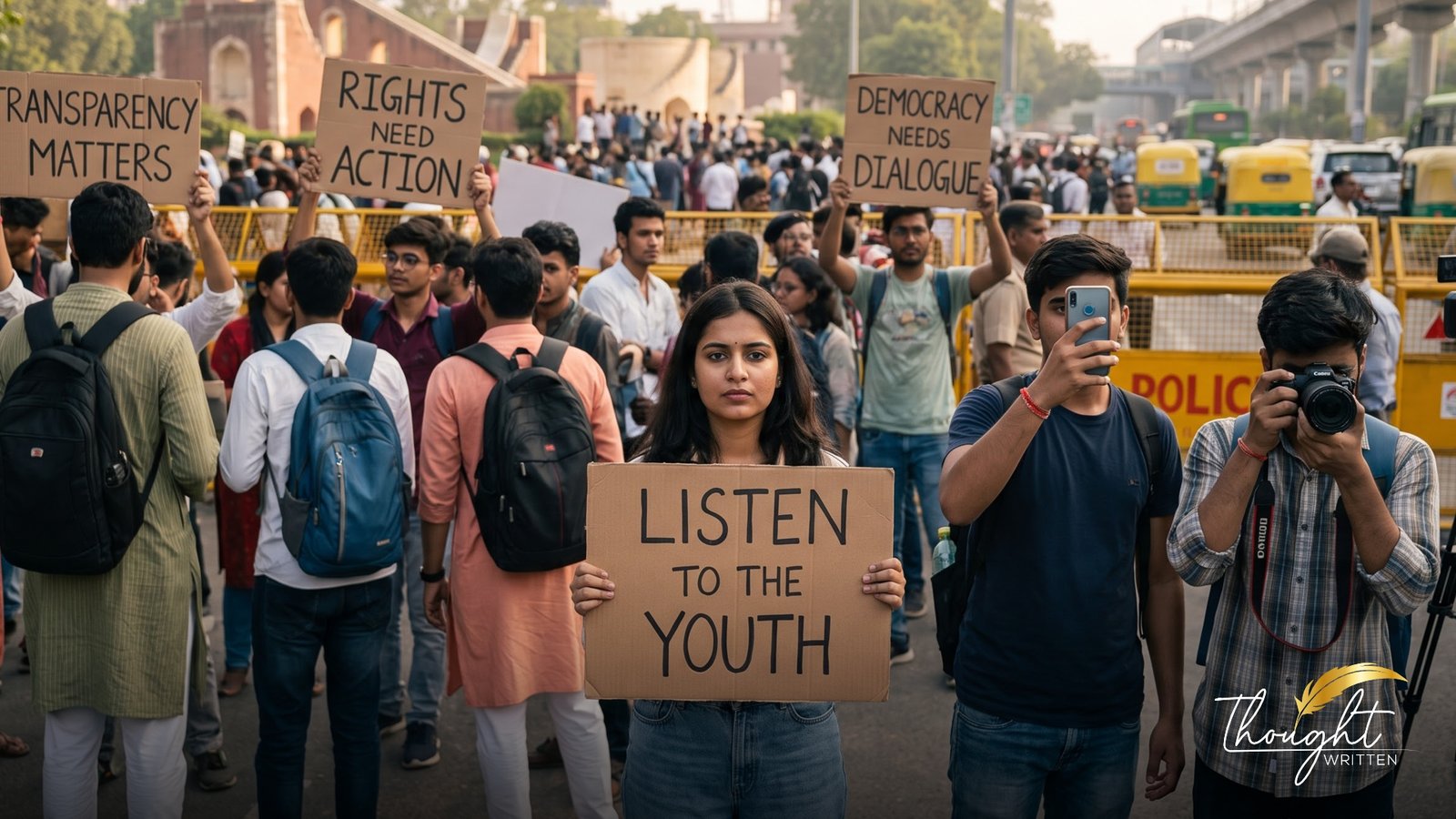
It seems that something unusual and unprecedented is taking place on the streets of the world. There are no official leaders of these protests, manifestos, or flags. However, the same words appear in posters, hashtags, and headlines all over the world – Gen Z.
People thought for quite a long time that generation Z is indifferent, distracted, and too much involved in virtual reality to pay attention to the problems of the real world. Nevertheless, over the past couple of years, young people from 1997 to 2012 proved themselves to be active participants in political life and even leaders of political uprisings. They caused the collapse of a government in Nepal, forced a President to leave his office in Madagascar, and pushed forward anti-corruption movements in Indonesia, the Philippines, Morocco, Peru, and other countries.
Protest Movements in the Age of Global Protest
What stands out about these new protest movements is the sheer simultaneity of their actions. There are few things that politically and historically differentiate these nations, but they have all faced the same driving force over the past year. While the causes vary from nation to nation, water and power shortages, pension reform, education quotas, corruption scandals the emotions are one and the same: young people who see their governments as never having been intended for them.
In Nepal, protests over corruption and a now-lifted social media ban have led to the ousting of a prime minister. In Madagascar, the frustration over consistent blackouts of water and electricity has put the president on his feet as he has fled the country. In Morocco, protests have broken out over the misappropriation of government spending on infrastructure when the hospitals and schools were left neglected. In Mexico, protesters took to the streets under the slogan “Generation Z” to condemn corruption and drug violence.
None of these movements copied each other in any formal sense. But they were watching each other. Protesters in Madagascar have said they drew direct inspiration from what they saw happen in Nepal and, earlier, in Sri Lanka and Bangladesh. This is protest as an open-source project: tactics, slogans, and even aesthetics get borrowed, remixed, and redeployed within days across time zones and languages.
None of these protests formally took cues from each other. Yet they observed each other. Activists in Madagascar say they were inspired directly by what they witnessed unfolding in Nepal and, prior to that, in Sri Lanka and Bangladesh. This is open source protest activism: techniques, memes, even style get borrowed, mixed up, and appropriated almost immediately across time zones and languages.
The Internet Is Not Only a Tool, but a Battlefield
Each previous generation was forced to coordinate its efforts using land lines, fliers, and word of mouth. Gen Z is the first generation that was born and grew up entirely inside the internet. That is reflected in how it organizes. Discord servers are command centers. Signal groups deal with logistics that cannot be openly discussed. The emotional load is carried by Instagram and TikTok.
This is another reason so many of these movements are leaderless or close to it, since there is no one face to put in jail, defame, or deal with, since the organization itself is a horizontal network by design. It is possible to take out ten organizers, but a hundred more accounts are ready to pick up where the others left off. This is a huge strength for any organization, but at a high price that will become evident.
Finally, there is also a symbolic language, which persists even among countries with absolutely no common history: flags of pirates, allusions to anime, gaming symbolism. It appears to be random, almost humorous. But it is a common visual language for a generation of people who found their identity in the global space of the Internet, not in their native country, and it allows protesters to communicate immediately with those who understand it.
Why Now? The Economic Realities Behind the Anger
It would be a grave misunderstanding to view this merely as a social media event. There are concrete economic reasons behind the anger. Generation Z might be the most educated generation ever, but it is also the generation entering economies that give it much less mobility than its predecessors experienced higher levels of debt, fewer employment opportunities, and permanent unaffordable housing in major cities. Add to this a visible and aging political elite in nations whose average age is several decades higher than their citizens’ average age and you have a generation feeling locked out of decisions being made about its future.
Scholars of nonviolent campaigns have shown that campaigns involving substantial youth activism are more than two times as likely to succeed than those not involving such activism. Youth bring energy, creativity, and coalition-building skills across different social divides that may be harder for older activists to achieve. This is one of the key strengths of Generation Z, along with the numbers.
The Hard Part: Transforming Wrath into Revolution
This is where the story gets a little more complex – and a little more honest. Topp[ing]pling a regime, ousting a president, is the easy part when you consider the difficulties that lie ahead. Commentators who study these uprisings have noted that while Gen Z’s protest movements do not always adhere to a discipline of nonviolence like some movements before them, there has also been a brutal state backlash – mass arrests, and in the most extreme cases, violent crackdowns in countries like Bangladesh, Kenya, Tanzania, and Morocco.
Then there’s the problem of governance. It is harder to crush an ungoverned movement than it is to govern one. Elections, ministries, budgets all require the kind of robust and patient institutionality that ungoverned, tech-driven movements typically lack. The scholars who study this revolution are quite frank about this: without a strategy to transform street rage into a seat at the table, many of these uprisings risk achieving regime change without system change.
The tension became apparent almost immediately in nations that held elections after protests, such as Nepal and Bangladesh. The success of new administrations in the coming years will be determined by whether or not they will take into consideration the views of their young citizenry that called for their election, or continue the pattern of ignorance of the preceding leadership.
What Does Gen Z Protests Teach Us?
Ignore the memes and the Discord chats, and you’ll find that at heart, it is an age-old lesson: People will eventually find ways to make themselves heard when they have been ignored for too long. The difference is that the process has been accelerated: A protest in one nation could become the inspiration for a similar movement in another in days, instead of years. Another difference is that because of the speed of the movement formation, such movements are prone to fracture and loss of momentum at the same pace.
The more pertinent question is not “why is Gen Z protesting?”, but rather if those political establishments facing them are able to adapt, to bring down the median age of decision-making bodies, and incorporate Gen Z in the institutions rather than respond to their street protest. The very same experts who study this phenomenon claim that until such a shift is made, the sequence will continue: a trigger, a viral wave of reaction, a capitulation, and the quieter battle for true change.
For a generation whose formative years were marked by one failure after another of institutions in economic, environmental and political arenas, taking to the streets is hardly an overreaction, but the natural result of running out of patience and the most powerless generation realizing that it has no other means left but using the only power they have – numbers.