
AI is presented as technological advancement that can help humanity solve a range of issues ranging from energy to resources problems. However, this technology itself requires enormous infrastructure, electricity, cooling systems and physical resources to work. The current AI age where use of generative AI, AI assistants, AI search, image/video generation has increasingly caught speed. …
Can AI Become Sustainable? The Hidden Environmental Cost of the AI Boom
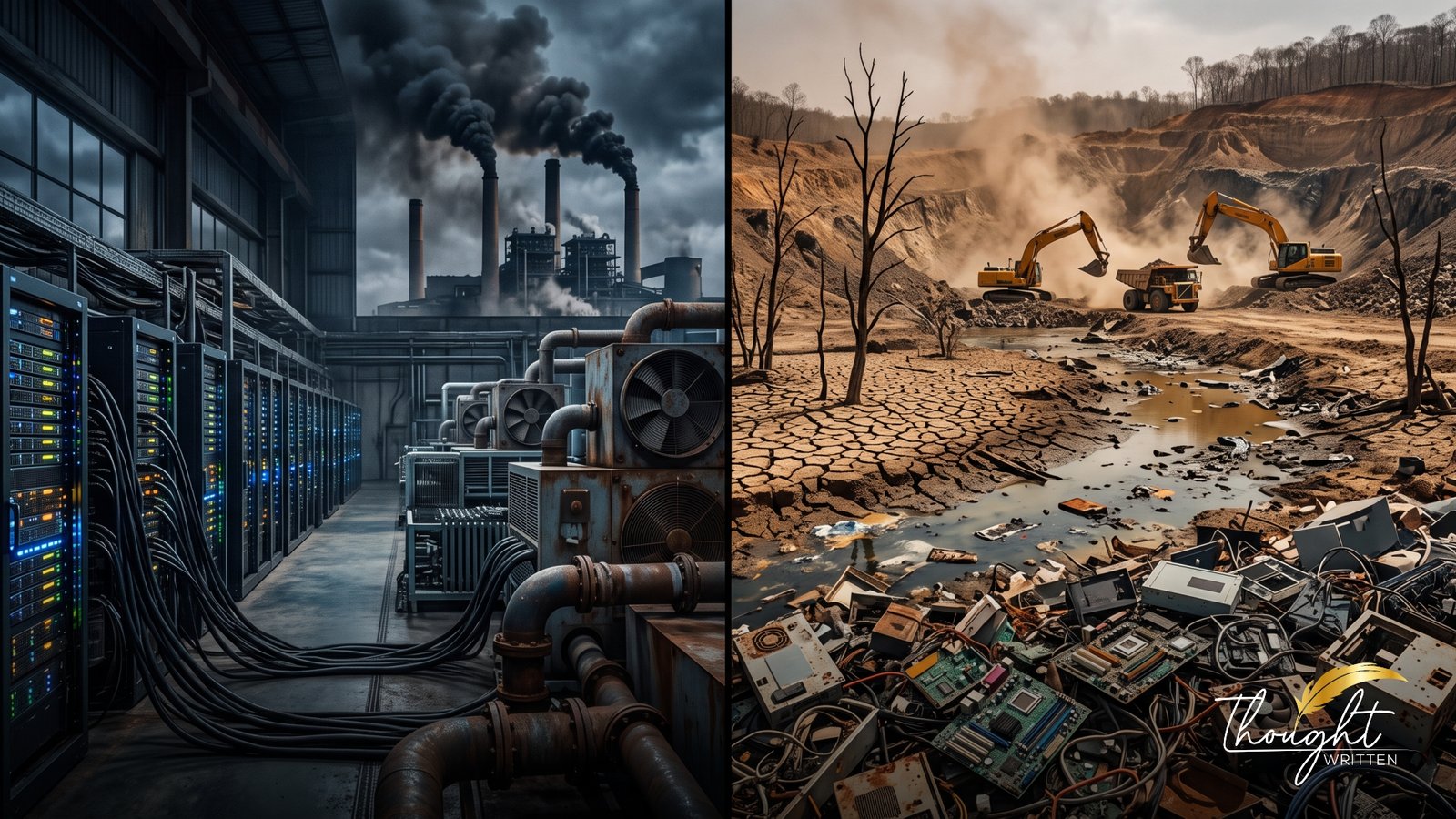
AI is presented as technological advancement that can help humanity solve a range of issues ranging from energy to resources problems. However, this technology itself requires enormous infrastructure, electricity, cooling systems and physical resources to work.
The current AI age where use of generative AI, AI assistants, AI search, image/video generation has increasingly caught speed. Yet the big question of the century is
“Can a technology consuming significant resources become a part of a sustainable future?”
Perhaps to answer this AI sustainability kicks in.
Why AI has an Environmental Footprint
AI models are large and these large models require enormous computing power. There are thousands of specialised chips that work simultaneously. Training these AI models can take days or weeks. For this, there is continuous requirement and use of electricity. This was about training the models wherein the model is just being built. Now imagine how using the model would impact the environment. Every chatbot question being asked or AI image being generated or any AI search, voice interaction or an automated business task that you give to AI requires computing resources. Now when you use the AI model, it is going to end up using the environmental resources in a huge amount. Also, the third thing, AI does not magically exist in the cloud. It depends on data centres, servers, GPUs, networking equipment, cooling infrastructure and electricity grids. Basically, the AI data centres use a lot of natural resources that impact the overall environment. The AI energy consumption is also very high, especially when you’re training the models. And the environmental impact of AI thus is even bigger.
It’s not just Electricity
Discussions have actually reduced Ai’s environmental impact to just electricity consumption. Yes, electricity is being used in training models, however, the footprint AI’s environmental impact is much broader. Actually, the data centres generate tremendous heat now. The cooling systems in place require resources, including water. In some of these facilities, the cooling infrastructure is such that they need water-intensive systems and in order to do that the local water availability needs to be figured out. This creates a growing pressure on the environment.
Air infrastructure also requires a lot of hardware and raw material. They need advanced processors, servers, networking equipment, storage, and semiconducting manufacturing. Now this creates environmental costs before the AI system is even deployed. This depicts a huge AI carbon footprint picture all over the world.
Even with the rapid hardware upgrade there’s another issue which is electronic waste. You might question what happens to yesterday’s hardware when tomorrow’s models require the more powerful chips. Well this creates E-waste that keeps on building constantly all due to hardware replacement. It is advisable to opt for recycling and choose responsible supply chains to resolve this issue.
It is highly required to use sustainable technology that can aid the use of AI and ensure that the AI carbon footprint is reduced.
Why AI’s Environmental Impact is an Issue
A company may claim that it is reducing its carbon footprint but at the same time it increases the use of AI tools. They use these AI tools across units such as marketing, customer service, HR, analytics and software development. But again are the companies thinking of the environmental cost of their AI adoption?
AI sustainability is increasingly connected to corporate reputation, ESG commitments, investor and customer expectations, regulatory pressures and business operational costs. And so companies must adopt AI not with the idea of ‘Can AI do this task?’ but with ‘Is AI the most and the only efficient way to do this task?’
Adopting green technology practices and focusing on AI sustainability is the only way out of AI’s environmental impact.
Can AI actually solve environmental problems?
While AI data centres use up a lot of electricity and fresh water, it helps to optimise the usage of energy too. AI can help forecast energy demands and it also optimises the electricity grids thus reducing the energy waste and managing the renewable energy resources effectively. AI also analyses enormous datasets to improve its climate prediction and disaster forecasting. This can help to take preventive measures beforehand.
AI also supports precision irrigation, monitors crops actively and does a detailed soil analysis helping in using agricultural resources optimally. It can also identify inefficient supply chains and provide strategies to effectively manage transportation. In these ways sustainable AI usage can change a lot of environmental problems. Hence, one thing we again need to ask ourselves is not how AI is environmentally good or bad but it if AI creates enough value to justify the resources that it is consuming.
Green AI
Green AI focuses on developing as well as deploying AI with resource efficiency as a top notch priority. There can be smaller AI models developed that do not use up as much of resources and yet can work efficiently towards smaller tasks. Using better hardware and software can also reduce energy requirements. Using model optimization techniques such as model compression, efficient architectures, better inference and task specific models can reduce the computation requirements of AI.
The most important aspect is to use renewable sources of energy so that the data centres can be powered through wind and solar energy. This electricity usage would be generating a low carbon footprint and would thus make the environmental impact a lot less dangerous.
Role of Data centres in AI Sustainability
It’s common knowledge that the AI infrastructure race is at its peak now. Yet, the data centres may adopt some AI sustainable choices to make AI usage less of a global cause. Data centres should use innovative means such as using liquid cooling systems, or having improved thermal management in place so as to reduce the fresh water demands. They may even use hardware that uses renewable sources of energy and make energy procurement less stressful. The idle or underutilised hardware waste can either be used somewhere else effectively or can be recycled to better manage waste.
Businesses should audit AI usage to identify where AI is being used and if it is actually necessary. Choosing efficient model systems and avoiding unnecessary AI generation such as for drafting an email or for customer interaction can help to use AI effectively. Thus AI sustainably begins with our mindfulness.
AI Transparency
When usage of AI is so common, then so should its transparency be. It is utmost important to be transparent about the energy use, emissions and water consumptions due to AI usage. The users should be made aware of model efficiency, infrastructure and sustainability claims of AI. There should be some reporting requirements set in future that can make the government, business and the users aware of how AI is actually using resources.
AI sustainability is possible if the models are made to be more efficient and the hardware improves. When data centres use cleaner energy and the cooling becomes more efficient, only then can AI sustainability be achieved. Yet, efficiency alone is not enough. If AI becomes cheaper and easier to use, people may use it far more than needed. Well, this actually is the rebound effect.
AI is not sustainable or unsustainable. AI sustainability depends highly on the environmental impact of how models are built, where they run, what powers them, and how intelligently they are being used. The future is about building AI systems that are naturally sustainable keeping the end in mind. The next AI-gen should be more efficient, transparent and more sustainable.